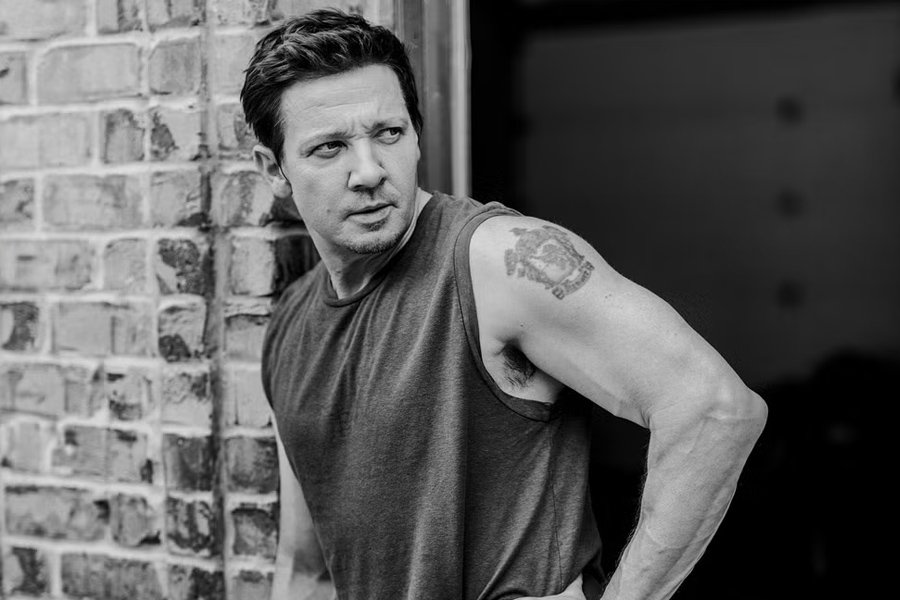
A public figure with private gravity
I have always been drawn to performers who seem to carry weather inside them. Jeremy Rener is one of those people. He does not feel like a shiny headline machine. He feels more like a forged tool, heated, hammered, cooled, and used again. That quality matters because his story is no longer only about movies, or even about fame. It is about adaptation, about what happens when a life built on motion is forced to pause and then learn a new rhythm.
What makes Jeremy Rener especially interesting now is not simply that he survived a catastrophic accident. It is that he turned survival into a new chapter instead of a final one. Many public stories flatten after a crisis. His has gained texture. There is the body he had to rebuild, the family he had to keep close, the work he still wanted to do, and the voice he found again in music and writing. I read that arc as less like a comeback tour and more like a second construction project, one beam at a time.
The memoir as a map of pressure and repair
A memoir changes the shape of a celebrity story. It takes the spotlight and turns it into a lamp. In Jeremy Rener’s case, the book does something even more interesting. It pulls the focus inward, toward the mechanics of endurance. That matters because memoir is where image becomes muscle. It is where the public version of a person meets the private version and has to sit at the same table.
I think this is one of the most useful ways to understand him now. The accident gave the world a dramatic image. The memoir gives the world a method. It invites readers into a slower reality, where recovery is not a heroic montage but a repeated negotiation with pain, fear, fatigue, gratitude, and stubbornness. There is a kind of honesty in that. Not polished honesty. The rough kind. The kind that still has dust on it.
The fact that his daughter is tied to the audiobook edition adds another layer. It makes the project feel less like a monument and more like a family record. For a father, that changes everything. A story is no longer only about legacy in the abstract. It becomes about what a child hears, what they inherit, and how a parent chooses to be remembered.
Family life as the hidden architecture
Public profiles often list family as if it were a footnote. In reality, it is usually the structure holding the whole house up. Jeremy Rener’s family story has become part of how people read him, especially after the accident. Fatherhood, in particular, has been more than a personal detail. It has functioned like a compass needle.
I find that compelling because the most vivid part of resilience is often not ambition but attachment. A lot of people can push through pain for a job. Fewer can reorganize their entire sense of self around the people who depend on them. That kind of devotion is less cinematic, but more durable. It has the grain of wood, not the glare of metal.
There is also value in acknowledging the broader family circle. His sister Kym is not just a name attached to a profile. Through the RennerVation Foundation, family becomes action. It is one thing to talk about giving back. It is another to build an organization that supports foster and at-risk youth. That puts the family story into motion. It shows that Jeremy Rener is not only receiving care from his circle. He is also extending that circle outward.
Music, stillness, and the need to make things
I am interested in artists who refuse to stay in one lane. Jeremy Rener has done that for years. Acting gave him scale. Music gave him a different key. Renovation and production gave him something tactile, something to build with his hands. Those instincts are not random. They are all forms of composition.
Music, especially, feels important in the wake of injury. When the body becomes a project, sound can become a shelter. A song does not ask the same things a film set asks. It does not require the same physical choreography. It can be intimate, immediate, and unarmored. For a person rebuilding after trauma, that matters. It offers another way to breathe.
I also think his work with properties and renovation says a lot about his temperament. Some people collect things. Others restore them. The second group tends to understand time differently. They know that damage is not always an ending. Sometimes it is a prompt. A cracked wall can reveal a better structure underneath. That is a powerful metaphor for his life after the accident, but it also stands on its own as a way of seeing the world.
The post-accident image is not only about survival
The public often treats recovery stories as simple before and after photographs. That is not how bodies work. That is not how people work. Jeremy Rener’s later chapters matter because they resist that simplification. He is not just a man who lived through something terrible. He is a man who had to renegotiate daily life in public view.
That kind of visibility is rare and heavy. Every step is observed. Every scar becomes a symbol. Every appearance gets translated into a narrative of triumph or fragility, sometimes both at once. I think the more interesting truth is less dramatic and more human. Recovery is repetitive. It can be frustrating, humiliating, dull, thrilling, and uneven all in the same week. What makes his story stick is that he did not hide that unevenness. He let it remain visible.
That visibility has value for audiences because it expands the definition of strength. Strength is not only lifting. It is returning. It is asking for help without disappearing. It is learning to trust a changed body. It is making art while still healing. Jeremy Rener’s story now lives in that tension.
Why the work still matters
It would be easy to reduce Jeremy Rener to one franchise role or one accident. Both would be too small. His career has always moved in two directions at once. On one side, the blockbuster machinery. On the other, the quieter roles that ask for restraint, tension, and an almost unblinking gaze. That balance is part of his durability.
I think audiences respond to him because he often plays people who look like they have already taken a few hits from life. He has a face and a presence that can hold pressure without splintering. That kind of screen identity is not built by accident. It comes from choosing roles that have bruised edges. It comes from treating performance like carpentry, with fit and finish both mattering.
What is newer now is that the same qualities read differently off screen. The actor who once seemed especially convincing as a man under strain is now also someone who has lived through strain in a deeply public way. That gives his work a different charge. Even when he returns to familiar territory, the audience is meeting a changed man.
FAQ
Who is Jeremy Rener?
Jeremy Rener is an actor, producer, musician, and author whose public identity now includes both his film career and his recovery story. He is known for playing intense, grounded characters, but his recent years have added a more personal layer centered on family, resilience, and creative rebuilding.
Why has Jeremy Rener become such a compelling figure beyond acting?
I think it is because his story combines success, injury, recovery, and reinvention without collapsing into sentimentality. He has remained active in creative work while also making his personal recovery part of the public record. That combination gives his life story unusual depth.
What is new about his recent phase of life?
The most notable newer chapter is his memoir era, which shifts him from performer to narrator. Alongside that, he has stayed active in television and film, expanded his family-centered public image, and kept music in the mix as another creative outlet.
How does family shape his public story?
Family is central to how Jeremy Rener is now understood. His daughter is a major emotional anchor in his public life, and his sister Kym is connected to philanthropic work through the RennerVation Foundation. Family is not just background in his story. It is part of the engine.
What does his recovery represent to fans?
To many fans, it represents more than survival. It represents persistence under pressure. His recovery has become a story about returning to life with a changed body and a changed outlook. That makes him feel less like a celebrity myth and more like a real person under a brighter light.
Does Jeremy Rener still make music?
Yes. Music remains part of his creative identity. It gives him a different register from acting, one that feels more intimate and emotionally direct. In that sense, music is another room in the same house of expression.
Why does Jeremy Rener continue to attract attention?
Because he feels unfinished in the best possible way. He is not frozen in the role that made him famous, and he is not defined only by the event that nearly ended his life. He keeps moving, keeps making, and keeps evolving. That is the kind of story people keep returning to.
Designing Industrial Spaces That Work As Hard As Your Equipment
The Attic Is Secretly Running Your Roof
When Your Air Conditioner Starts Acting Like A Drama Queen