From Los Angeles Roots to a Broader View of Health
Pam Ling’s story begins in Los Angeles, but it does not stay there for long. Her path moves with unusual range, from elite undergraduate study to medical training, then into public health, research leadership, and a place in popular culture that few physicians ever touch. What makes that arc memorable is not spectacle. It is the way each stage seems to widen the lens. She did not simply learn how to treat illness. She learned how to understand the forces that shape it.
That breadth matters. Medicine can be a close-up art, focused on the person in the exam room, the lab result, the immediate concern. Public health pulls the camera back. It asks why certain harms spread, who is being targeted, what systems are feeding the problem, and how policy might interrupt the cycle. Pam Ling built a career at the seam between those two worlds. That seam is where some of the hardest and most useful work happens.
Her education reflects that dual instinct. Harvard, UCSF, and UC Berkeley are not just impressive names in a row. Together they sketch a mind trained to move between clinical practice, scientific inquiry, and population level thinking. That combination gives her work a rare texture. It is practical without being narrow, and ambitious without floating away from real people.
The Unlikely Television Moment That Became Part of Her Story
In 1994, while still a medical student, Pam Ling stepped into a very different kind of classroom: The Real World: San Francisco. Reality television was still a fresh experiment then, less polished machine and more live wire. The show threw strangers together and let conflict, friendship, and vulnerability unfold in public. Ling arrived with a quiet center of gravity. She did not seem built for noise, but she did not vanish inside it either.
That contrast became part of her appeal. She represented a different kind of presence, one rooted in observation rather than performance. In a setting that often rewards the loudest voice in the room, her steadiness stood out. She was not defined by the format. The format merely revealed something about her temperament.
The series also placed her in close proximity to one of its most important figures, Pedro Zamora, whose activism and visibility left a lasting imprint far beyond television. The house was not just a social experiment. It became a moment where personal bonds, public health, and cultural memory converged. For Pam Ling, that convergence seems to have deepened rather than distracted from her larger commitments.
The show may have introduced her to many viewers, but it did not become the whole story. It was more like an unexpected doorway in a long hallway. She walked through it, and then kept going.
Building a Career Around Tobacco Control and Prevention
Pam Ling’s professional work is centered on a field where the stakes are both immediate and slow moving. Tobacco control is about disease, addiction, and death, but it is also about marketing, persuasion, and the mechanics of influence. That makes it a study in pressure systems. The product is only one part of the equation. The industry surrounding it matters just as much.
Her research has focused on how tobacco companies recruit and retain young users, how nicotine products are framed, and how those messages move through culture. This is not abstract theory. It is a close examination of the scripts that shape behavior. Advertising, branding, social media, and product design all become pieces of a larger machine. Pam Ling studies that machine, then looks for ways to jam the gears.
The rise of e-cigarettes and flavored products has made this work even more urgent. New products arrive wrapped in novelty, but their public health effects are often anything but new. They can make dependency look modern and harmless, like a wolf wearing a bright jacket. Researchers like Ling help cut through that disguise. They trace the path from appeal to uptake, and from uptake to harm.
At UCSF, her role as director of the Center for Tobacco Control Research and Education places her at the center of a field that depends on both evidence and persistence. Research alone is not enough. Findings must travel into classrooms, clinics, policy debates, and community settings. Her career suggests a steady commitment to that journey. Data does not stop at the page. It has to cross the street and enter the world.
A Public Health Mindset Shaped by Multiple Disciplines
One reason Pam Ling’s work resonates is that she approaches health like a layered landscape rather than a single road. Clinical medicine gives her a view of individual experience. Epidemiology and public health give her a view of patterns. Policy connects those patterns to action. When those disciplines work together, the result is sharper than any one of them alone.
This is especially important in prevention work. Prevention is often invisible when it succeeds. A young person does not start smoking, a harmful trend loses momentum, a campaign fails to gain traction. There is no dramatic scoreboard. The victory is absence, which is easy to overlook and hard to celebrate. Yet the impact can be enormous.
Pam Ling’s career has leaned into that kind of quiet effectiveness. Her interests include youth targeted marketing, cessation efforts for young adults, and the changing landscape of nicotine use. Each of those areas sits at a crossroads. One path leads toward vulnerability. Another toward protection. Her work helps determine which signs people see first.
There is also a certain discipline in this kind of research. It requires patience, because industries move quickly and public understanding often lags behind. It requires clarity, because complex topics can be blurred by jargon or spin. And it requires a moral spine, because the questions are never purely technical. They are about who gets harmed, who profits, and who gets protected.
Family Life Kept Close to the Chest
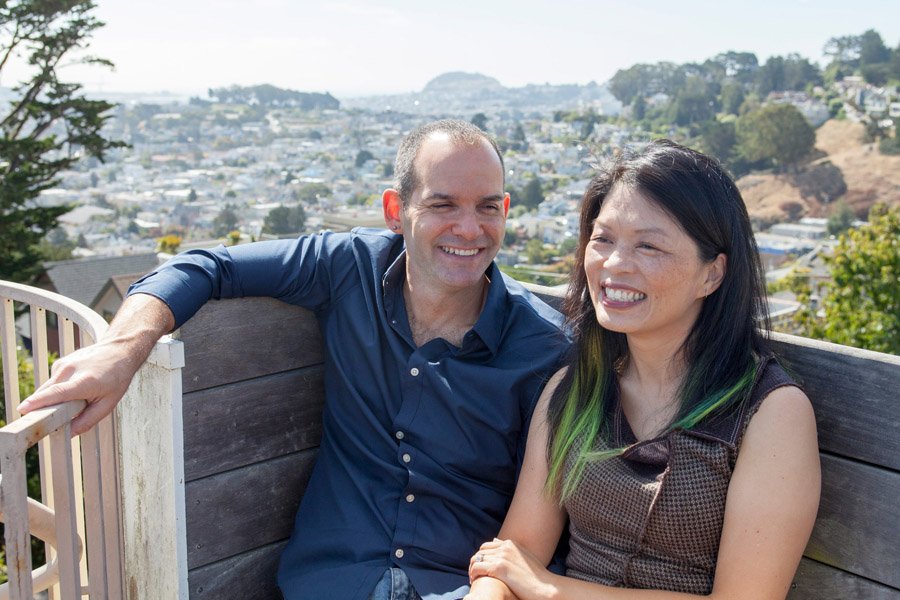
Pam Ling’s personal life has remained notably private, which feels consistent with her public manner. She and Judd Winick married in 2001 and have two children, a son and a daughter. The details they choose to share are limited, and that restraint gives their family life a grounded quality. In an age when many public figures turn every milestone into content, their privacy feels almost old fashioned, like closing a window before lighting a lamp.
That choice says something important. Public visibility does not have to consume the whole person. A person can have a recognizable public history and still keep the center of family life protected. For Ling, that boundary seems deliberate rather than accidental. Her work is public. Her family life is not for display.
This balance is easy to underestimate. Professional life often rewards exposure, but not every part of a life should be exposed. The ability to hold some things back can be a form of strength. It gives shape to the rest.
Why Pam Ling Still Matters in the Present
Pam Ling remains relevant because her story touches several worlds at once. She is a physician, a researcher, a professor, a former reality television cast member, and a public health leader. Those roles might look unrelated from a distance, like separate rivers. Up close, they feed one another. Her medical training gave her a language for care. Her public health training gave her tools for scale. Her television appearance gave her cultural reach. Her research gave her lasting purpose.
That mix is rare. More rare still is the impression she leaves. She does not come across as someone chasing spotlight for its own sake. She feels more like someone who took an unusual route and then used every turn to do real work. That matters in a world often drawn to the flashy and forgetful.
Pam Ling’s career is a reminder that impact does not always arrive with a trumpet blast. Sometimes it looks like careful study, long hours, and a refusal to accept avoidable harm as normal. Sometimes it looks like a steady hand in a noisy room. Sometimes it looks like the patient accumulation of evidence, one finding at a time, until a clearer path begins to appear.
Building Search Visibility Without Chasing Magic Tricks
Building A Backlink Reputation That Search Engines Trust
Building An Arizona Home That Outsmarts The Sun
The Attic Is Secretly Running Your Roof
The Modern Writers Toolkit For Turning Ideas Into Publishable Stories